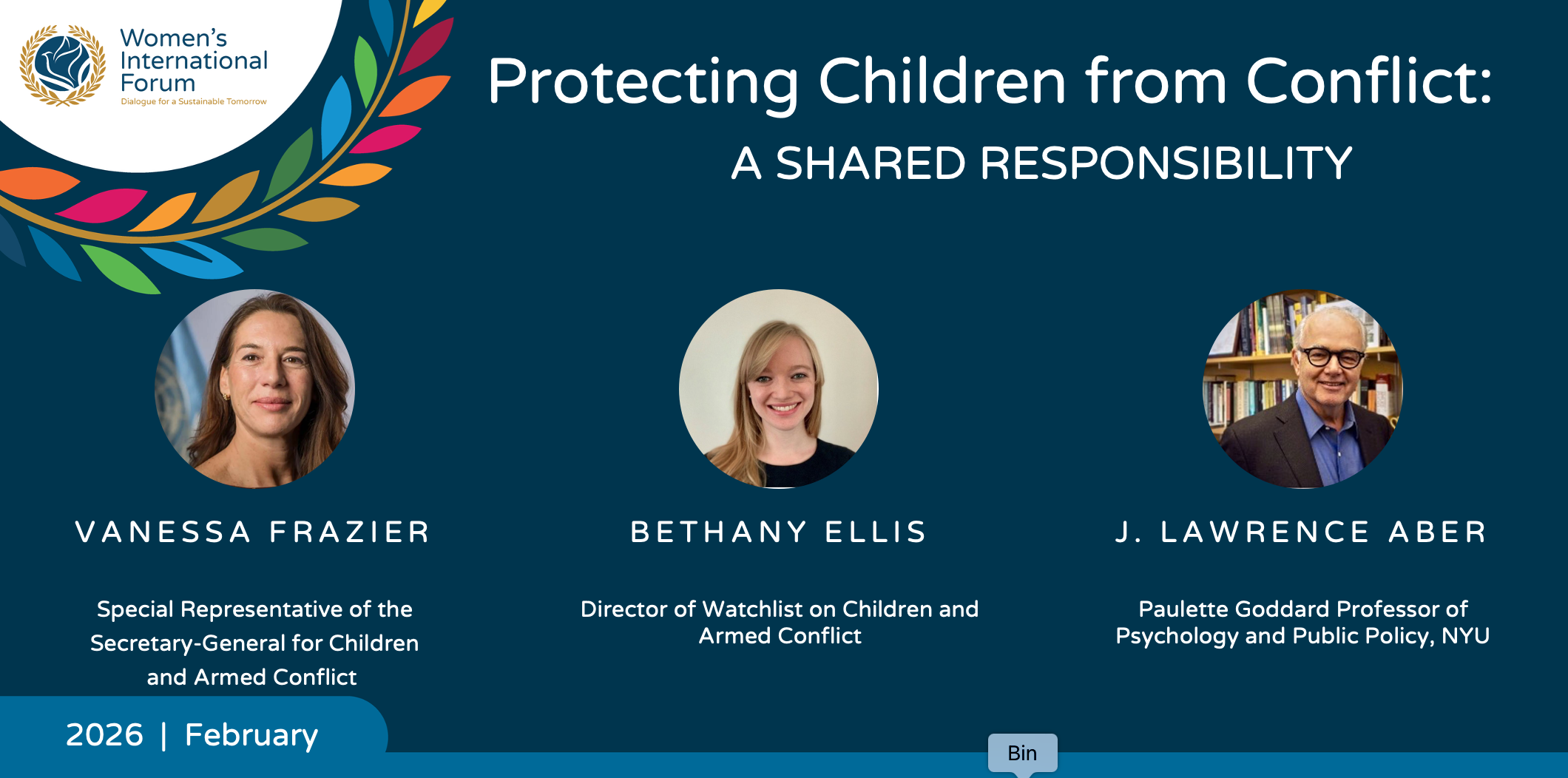
Protecting Children From Conflict: A Shared Responsibility
Over the past decades, the international community has made clear commitments to protect children affected by armed conflict. These commitments are grounded in international law, reinforced through United Nations mechanisms, and reaffirmed year after year in global forums. Yet the lived reality for millions of children tells a far more troubling story. Recent United Nations reporting illustrates the scale and urgency of the challenge. In 2024, the UN verified 41,370 grave violations against children, the highest number recorded since the Children and Armed Conflict mandate began and a 25 percent increase compared to the previous year.
The report documents 22,495 children affected, with particularly sharp rises in attacks on schools and in rape and other forms of sexual violence. These figures underscore a growing gap between global commitments and effective protection on the ground.
Across conflict-affected regions, children face risks that extend well beyond the battlefield. Armed violence disrupts education, displaces families, restricts humanitarian access, and leaves lasting physical and psychological scars. The UN’s Children and Armed Conflict agenda identifies six grave violations against children: killing and maiming, recruitment and use, rape and other forms of sexual violence, abduction, attacks on schools and hospitals, and denial of humanitarian access. These violations are not isolated incidents. They are warning signs of how quickly childhood can be stripped away when protection is not treated as a priority.
At the same time, experience shows that harm is not inevitable. Where leadership is present, accountability is pursued, and protection is prioritized, progress is possible. The Secretary-General has urged Member States to reinforce their commitment to child protection, including through the Prove It Matters campaign, which emphasizes the importance of turning evidence and reporting into concrete action and measurable impact.
The Discussion:
Building on WIF’s tradition of examining the space between intention and impact, this discussion will explore how global commitments translate into real protection for children affected by war.Anchored by Ms. Vanessa Frazier, Special Representative of the Secretary-General for Children and Armed Conflict, the panel will feature the specialized insights of Ms. Bethany Ellis on NGO monitoring and advocacy, and Dr. Lawrence Aber on the psychological and developmental impact of conflict on children. Together, they will explore where responsibility, leadership, and sustained attention remain essential to closing the gap between reporting and concrete action.
Objectives:
- Provide a forum for informed exchange on the protection of children affected by armed conflict, drawing on global experience and current realities.
- Examine implementation of international commitments and identify where gaps between intention and outcome persist.
- Offer insight into the mandate of the Special Representative of the Secretary-General, alongside the critical roles of civil society and academic research.
- Highlight key trends and concerns emerging from recent United Nations reporting on children and armed conflict.
- Discuss the role of leadership, accountability, and cooperation in preventing the six grave violations against children.
- Explore the importance of education, humanitarian access, and long-term recovery in safeguarding the well-being of children affected by war.
- Encourage constructive reflection on the shared responsibility of Member States, institutions, and individuals in strengthening the protection of children in conflict situations.
Speakers
-
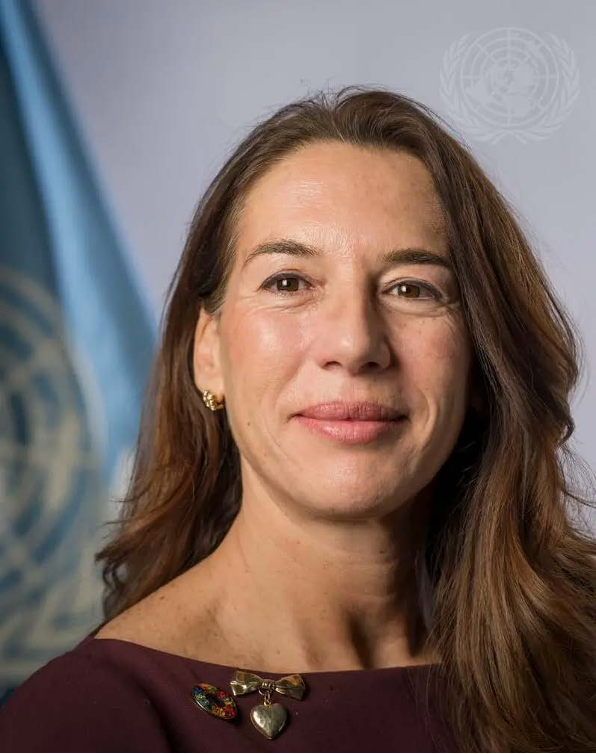 Ms. Vanessa FrazierSpecial Representative of the Secretary-General for Children and Armed Conflict
On 3rd October 2025, Vanessa Frazier of Malta was appointed Special Representative for Children and Armed Conflict. Ms. Frazier, who recently served as Ambassador, Permanent Representative of Malta to the United Nations (UN) in New York, USA (2020-2025), brings multilateral diplomatic expertise, crisis management skills, consensus building and dedication to child protection, with ability to navigate complex global negotiations and broker agreements among diverse stakeholders, having played a pivotal role as Chair of the UN Security Council (UNSC) Working Group on Children and Armed Conflict.
She presided over the UNSC in February 2023 and April 2024, and as UNSC Facilitator of the Iran/Joint Comprehensive Plan of Action agreement and Chair of the 1267 Sanctions Committee on Al Qaeda/Daesh, advanced human rights, child protection, and humanitarian language. As an advocate for the E10 group of elected UNSC members, she was instrumental in shaping international responses to pressing crises, ensuring that the voices of the most vulnerable, especially children, remained at the forefront with a focus on the protection of children affected by conflict. She also served as Vice President of the 74th UN General Assembly and Chair of the Second Committee (Economic and Financial), leading the first and only all-women bureau in UN history.
During her diplomatic career, Ms. Frazier served as Malta’s ambassador to NATO from 2011-2013, adding the role of ambassador to Belgium and Luxembourg in 2012; as Malta’s Ambassador to Rome, Italy (2013-2019); as Acting Permanent Secretary, Ministry of Foreign Affairs of Malta (2012-2013); as Ambassador for Migration, Office of the Prime Minister, Malta (2012-2016); and as Ambassador of Malta to Brussels, Belgium (2012-2013). Ms Frazier holds a Doctorate Honoris Causa in Humane Letters, Luther College, Decorah, Iowa, USA (2018-2019); a Master’s in Diplomatic Studies with a major in International Law, University of Malta (1993-1995). She is fluent in Maltese, English, and Italian.
-
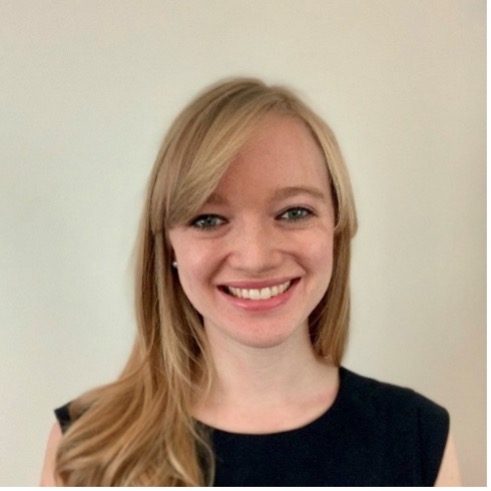 Bethany EllisDirector of Watchlist on Children and Armed Conflict
Bethany Ellis is Director of Watchlist on Children and Armed Conflict – a network of 16 humanitarian and human rights organizations seeking to end violations against children and protect their rights in war.
Until taking over as Director in early 2025, she led Watchlist’s advocacy efforts to defend and progress the UN’s Children and Armed Conflict agenda from 2019. Some of her key contributions include co-organizing seven CAAC policy workshops, supporting three UN Security Council CAAC Working Group chairs throughout their tenures, leading our collective engagement around five Security Council open debates on CAAC, authoring Watchlist’s 2024 policy note on explosive weapons and CAAC, and coordinating Watchlist’s contributions and advocacy during the negotiation of Security Council resolutions 2601 (2021) and 2764 (2024).
Prior to joining Watchlist, Bethany conducted research and policy analysis for various global human rights organizations on issues relating to human trafficking, education in emergencies, and the rights of refugee and migrant children.
She holds a master’s degree in public policy from the Harvard Kennedy School and a bachelor’s degree in international political economy from Georgetown University’s School of Foreign Service. -
 Dr J. Lawrence AberPaulette Goddard Professor of Psychology and Public Policy, NYU
Lawrence Aber is the Paulette Goddard Professor of Psychology and Public Policy at the Steinhardt School of Culture, Education, and Human Development, and University Professor, New York University, where he also serves as board chair of its Institute of Human Development and Social Change and co-director of the international research center Global TIES for Children.
Dr. Aber earned his PhD from Yale University and an AB from Harvard University. He previously taught at Barnard College, Columbia University, and at the Mailman School of Public Health at Columbia University, where he also directed the National Center for Children in Poverty.
He is an internationally recognized expert in child development and social policy and has co-edited Neighborhood Poverty: Context and Consequences for Children (1997, Russell Sage Foundation), Assessing the Impact of September 11th 2001 on Children Youth and Parents: Lessons for Applied Developmental Science (2004, Erlbaum) and Child Development and Social Policy: Knowledge for Action (2007, APA Publications). His basic research examines the influence of poverty and violence, at the family and community levels, on the social, emotional, behavioral, cognitive and academic development of children and youth. Dr. Aber also designs and conducts rigorous evaluations of innovative programs and policies for children, youth and families, such as violence prevention, literacy development, welfare reform and comprehensive services initiatives. Dr. Aber advises and consults with media, public officials, private foundations and leading non-profit organizations who seek his opinion or advice about pressing matters concerning child and family well-being.
In 2006, Dr. Aber was appointed by the Mayor of New York City to the Commission for Economic Opportunity, an initiative to help reduce poverty and increase economic opportunity in New York City.In 2007, Dr Aber served as the Nannerl O. Keohane Distinguished Visiting Professor at Duke University and the University of North Carolina at Chapel Hill.
In 2008 and 2009, he served part-time as Visiting Research Professor in Evidence-based Social Interventions in the Department of Social Policy and Social Work, University of Oxford.He is a member of the Board of Directors of the Children’s Institute, University of Cape Town, South Africa, and was its Board Chair from 2008-2014. He served as consultant to the World Bank on its project, “Children and Youth in Crisis”.
From 2003-2006, Dr. Aber chaired the Advisory Board, International Research Network on Children and Armed Conflict of the Social Science Research Council, in collaboration with the Special Representative to the Secretary General of the United Nations on Children and Armed Conflict and UNICEF.Currently, he conducts research on: the impact of poverty and HIV/AIDS on children’s development in South Africa (in collaboration with the Human Sciences Research Council); the impact of preschool teacher training quality and children’s learning and development in Ghana (in collaboration with Innovations for Poverty Action); and on school- and community-based interventions in the Democratic Republic of Congo, Niger, Sierra Leone and Lebanon (in collaboration with the International Rescue Committee).