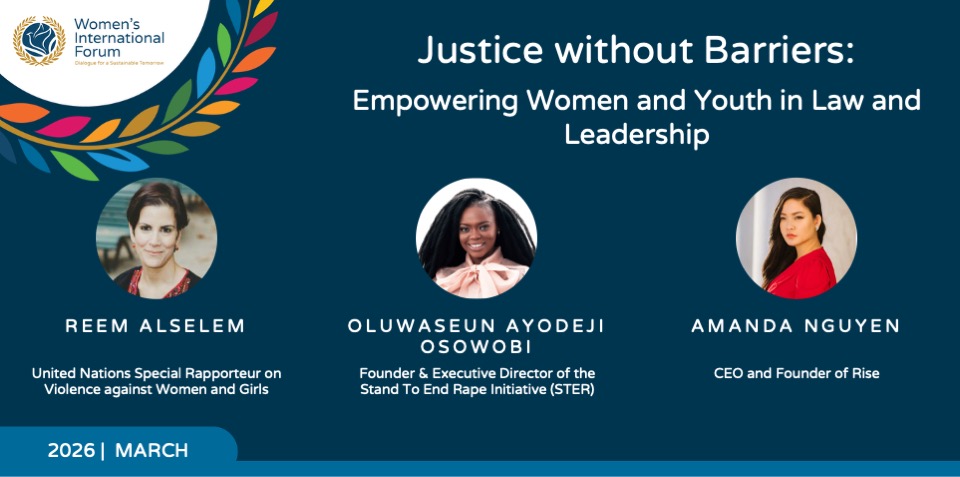
Justice without barriers: Empowering Women and Youth in Law and Leadership
In alignment with the 70th Session of the Commission on the Status of Women (CSW 70), this panel discussion examines innovative approaches to bridging gaps and overcoming barriers in ensuring access to justice for women and girls globally. Across the world, diverse stakeholders — young women leaders, governments, the United Nations, and civil society — are forging new pathways to dismantle systemic obstacles and transform justice systems into mechanisms that are truly responsive to women’s needs.
Despite decades of progress in establishing legal protections, significant barriers to justice persist. Women and girls continue to confront discriminatory laws, gender-biased judicial systems, and inadequate legal aid, as well as economic and technical constraints that sustain a troubling gap between legal frameworks and lived realities.
Within this landscape, young women have evolved from being at the forefront of social movements to becoming architects of modern legal frameworks. They bring innovation, urgency, and survivor-centered approaches to legal reform, leveraging lived experience to identify systemic gaps and design holistic solutions that address survivors’ realities. Through grassroots organizing and strategic advocacy, they are not only amplifying marginalized voices but actively shaping the policies and institutions that govern access to justice.
The broader international community has established robust frameworks to support these efforts. The Convention on the Elimination of All Forms of Discrimination Against Women (CEDAW), the Beijing Platform for Action, the Security Council Resolution 1325 and its subsequent resolutions on Women, Peace and Security provide normative foundations guiding member states in developing gender responsive legal systems. The Sustainable Development Goals—particularly SDG 5 on gender equality and SDG 16 on peace, justice, and strong institutions—further anchor the global commitment to equal access to justice.
Complementing these frameworks, the United Nations plays a critical convening and standard-setting role, providing technical assistance to member states, facilitating cross border cooperation, monitoring implementation of international commitments, and amplifying grassroots voices in global policy dialogues. At the national level, governments have enacted legislation to better protect women and girls and ensure their access to justice. Yet significant implementation gaps remain. The challenge now lies not only in strengthening legal frameworks, but in ensuring their effective implementation through sustained political will, adequate resource allocation, meaningful capacity building, and genuine collaboration across all stakeholders.
Objectives:
It is precisely at this intersection of grassroots leadership, international frameworks, and national responsibility that this seminar situates itself. This session not only highlights the inspiring journeys of young women leaders in bridging the gaps in justice—it also offers a deeper understanding of the United Nations’ role and efforts, alongside government-level success stories and challenges.
Specifically, the panel disccusion aims to:
- Understand how young women leaders are dismantling barriers to justice—and what it costs them.
- Increase visibility for successful models of youth-led legal reform and survivorcenteredadvocacy.
- Explore the convening and standard-setting role of the United Nations in advancingaccess to justice.
- Examine government best practices and challenges in implementing survivorcentric legal reforms.
- Foster multi-stakeholder dialogue on how collaboration and synergy can accelerate progress toward gender justice.
Speakers
-
 Ms. Reem AlsalemMs. Reem Alsalem, United Nations Special Rapporteur on violence against women and girls
Ms. Reem Alsalem was appointed United Nations Special Rapporteur on violence against women and girls, its causes and consequences in July 2021 by the UN Human Rights Council for a three-year tenure. She started her tenure on 1 August 2021.
Reem Alsalem is an independent consultant on gender issues, the rights of refugees and migrants, transitional justice and humanitarian response. She has consulted extensively for United Nations departments, agencies and programmes such as UN-Women, OHCHR, UNICEF and IOM, as well as for non-governmental organizations, think tanks and academia. Previously, she worked as an international civil servant, serving with the UNHCR in thirteen countries. During her service, she has planned, implemented, and monitored programs that served to protect persons that were survivors of gender-based violence, particularly women and girls.
She has also been a visiting professional with the Prosecutor’s Office of the ICC from January to March 2009 and a visiting researcher with the Feinstein International Center of Tufts University in December 2008. Visiting Professional, Investigation Unit of the Prosecutor Office, International Criminal Court, the Hague, the Netherlands, January 2009-March 2009.
Reem has a Master’s in International Relations from the American University in Cairo, Egypt (2001) and a Masters in Human Rights Law from the University of Oxford, United Kingdom of Great Britain and Northern Ireland (2003).
-
 Ms. Oluwaseun Ayodeji OsowobiFounder and Executive Director of the Stand to End Rape Initiative (STER)
Oluwaseun Ayodeji Osowobi is a multi-award winning gender equality advocate with six years experience in deploying effective solutions to challenge systemic social barriers that promote violence against women and girls and utilising social and behaviour change communication to improve SGBV knowledge, attitudes and practices in order to achieve Gender Equality. She is the Executive Director of Stand to End Rape Initiative (STER), a leading NGO that adopts a comprehensive approach of working with communities to generate sustainable homegrown
solutions and partners with local and national groups on systems-level prevention and intervention, while providing holistic psychosocial support to survivors in Nigeria. The organization has provided support to over 350 women, girls, boys and men and reached about 200,000 Nigerians with information.Oluwaseun fosters systemic change by providing capacity building support on violence prevention and intervention initiatives to governmental and non governmental institutions as well as supporting policy advocacy to enjoin the Nigerian Government for the passage of gender-centred Laws. In 2019, Oluwaseun partnered with BBC Africa Eye on the #SexforGrades documentary to highlight sexual harassment in Nigerian tertiary institutions. Through this effort, the Sexual Harassment in Tertiary Institution Prohibition Bill was relaunched at the National Assembly and passed third reading.
In recognition of her work, Oluwaseun was recognised as a TIME 100 NEXT and the Commonwealth Young Person for the Year 2019.
-
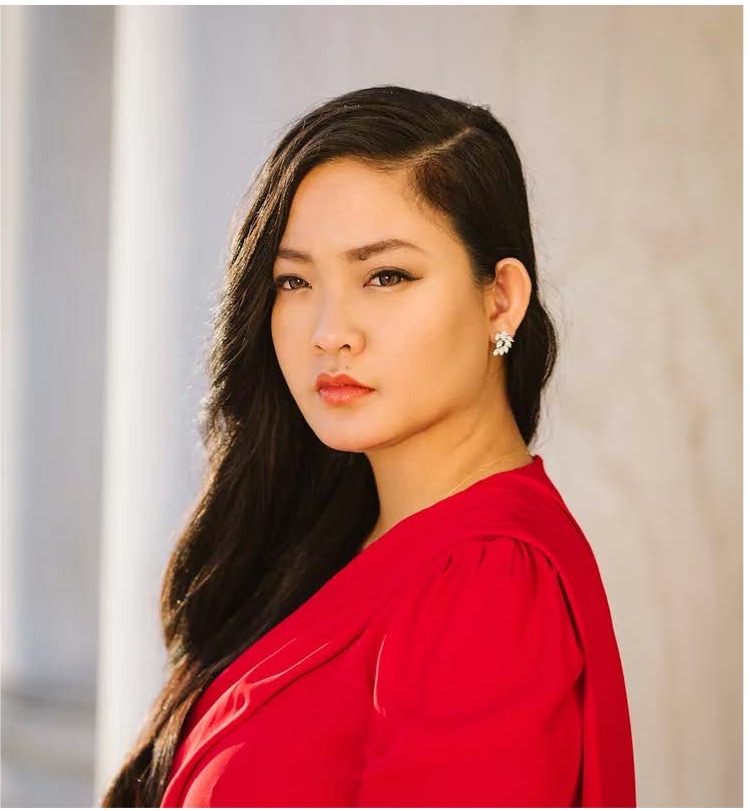 Ms. Amanda NguyenCEO and Founder of Rise
Amanda Nguyen is the CEO and founder of Rise. She penned her own civil rights into existence and unanimously passed the Sexual Assault Survivors’ Bill of Rights, after having to navigate the broken criminal justice system after her own rape. Eleven other laws protecting sexual violence survivors have been created modeled off of her federal law. The federal law was the 21st bill in modern US history to pass unanimously on the record.
Amanda has been named a Forbes 30 Under 30, by Foreign Policy as a Top 100 Leading Global Thinker, Marie Claire as a Young Woman of the Year, and The Tempest’s #1 Woman of Color Trailblazer. Previously, Amanda served at NASA and was appointed by President Barack Obama to the United States Department of State as his Deputy White House Liaison. Amanda graduated from Harvard University.